
The Problems We Face In Education Today
What is the state of teacher mental health in America?
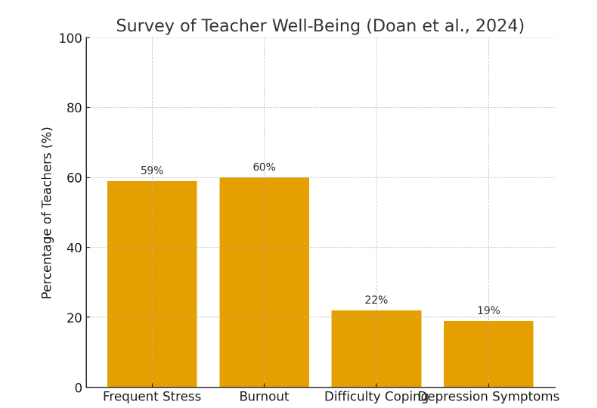
"In a 2024 survey of 1,479 teachers nationwide, 59% of respondents reported frequent job-related stress, 60% reported burnout, 22% reported difficulty coping, and 19% reported symptoms of depression (Doan et al., 2024). These rates are much higher than working adults in other industries."
-Matlach, L & Denton, P. (2024). "Supporting Teacher Mental Health". Comprehensive Center Network, Region 8 Indiana, Michigan, Ohio
What does faith look like in the United States?
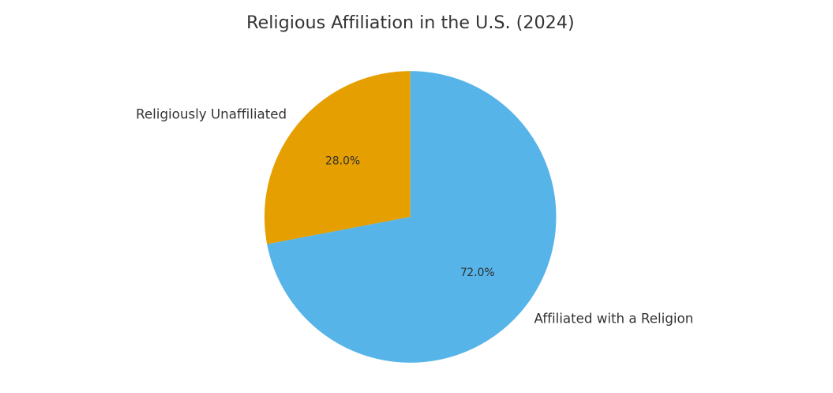
"Today, about 28% of U.S. adults are religiously unaffiliated, describing themselves as atheists, agnostics or “nothing in particular” when asked about their religion."
-Pew Research Center Report (2024) Religious ‘Nones’ in America: Who They Are and What They Believe
What Is the future of Artificial Intelligence (AI) In the United States?
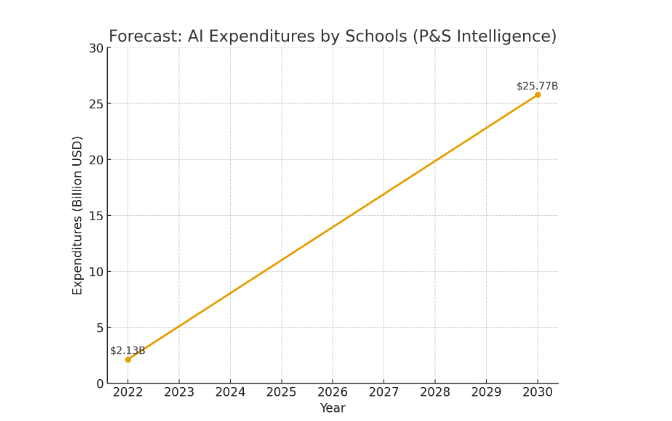
"According to a new forecast by P&S Intelligence, expenditures for AI by schools will grow from $2.13 billion in 2022 to $25.77 billion in 2030."
-Nagel, D. (2023). AI to Experience Massive Growth in Education -- THE Journal
DOXA Monthly Article
Qualia Vs. the Machine
Jan/Feb. 2026
Rania Assily

When I think about the current health of the state of mind in the U.S., my immediate thought goes to Aldous Huxley’s Brave New World. In his second chapter, Huxley introduces the infant nurseries where neo-Pavlovian techniques are used to condition a caste of Deltas (young infants conditioned to dislike reading and flowers). The narrator asks the Director why they go through such measures to make Deltas dislike flowers? The Director responds that the children consumed love of nature and being in the country too much and that they were conditioning them solely to dislike flowers, but not to dislike consuming transportation. Consumption, in other words, was the goal. If enough Deltas could consume what fed economic policy, all would work out for the State to thrive.
But the State is not the mark of excellence. The individual is. Huxley's book published in 1932 helped to expose technology's impact on the individual, converting him from human being to a number contributing to mass consumer potency.
Since time immemorial individuals discerned the value of ingenuity and innovation in the form of machinery. There is no real rhyme or reason for humans not to embrace machines. Civilizations adapted new machinery to make peoples’ lives more productive and efficient, but never to the detriment of their own minds and bodily capabilities. It has only been since the late 1800s, with industrialization, mass consumption, and standardization that man became his own worst enemy and a slave to a system lacking in creativity, human flourishing, and originality.
“Oh come on!” You might be saying, “Worse than the slavery of the pyramids of Egypt? Or worse than the forced labor conscription of the Great Wall in China?” After all, industry brought forth higher standards of living and opportunities in free societies for labor and capital to negotiate, qualia (human cognition, consciousness and sentience) strengthened, allowing people to better understand themselves in the form of cognitive reasoning and new psychological breakthrough. But did it though?
The answer is pretty straightforward. No. As human beings became more detached from nature and reliant on industrial machines, it became harder for us to reach our highest potential as rational beings, thus making us evermore easier to control. Modern slavery in the form of society's increasing reliance on technology has made modern human condition in many ways worse than slaves in the past.
I know what you are thinking..."Are you kidding me? Slaves had it 'better' in the ancient past?" Take a moment to allow rationality to sink in. Slaves could opt in the ancient world to learn some level of high skill and ownership of that skill which could over time, free them from bondage. One example, the Greek slave, Epictetus, who had learned philosophy as a slave and after freedom, became Rome’s leading Stoic master. Learning to read and write was the ultimate marker freeing one from a life of slavery. If you could advocate for yourself and reason for yourself, the power was endless.
Today’s slavery is in the form of high debt, mass consumer culture, willful illiteracy, lack of proper parenting and laziness and we need not look further than Generation Z, the first generation to reap the rewards of Western industrialization and standardization. The NAEP (National Assessment of Educational Progress) or national report card proves that fourth and eighth grade students who struggled in reading scored the worst in the past thirty years and in eighth grade math the gap between the highest and lowest scores is the widest in the test’s history. (Belsha, K. and Meltzer, E., 2025)
Is the recent covid pandemic to blame for these extremely high setbacks in education for the youth of America? Not fully. Every state in the Union has some level of decrease in reading scores since 2019 with Ohio joining several states with a significant decrease. (Belsha, K. and Meltzer, E., 2025)
One of the major culprits for Gen Z’s decline in qualia, particularly cognitive abilities, is the increased screen time and teaching methods reliant on technology. I have been in numerous schools and classrooms that rely solely on technology for learning and have witnessed quiet rooms with little to no engagement, surface-level thought, and students dropping classes because they did not read or did not want to. “While technology offers unprecedented access to information, it may also be reshaping how young minds process and retain knowledge. The constant barrage of notifications, short-form content, and multitasking could be affecting attention spans and deep learning capabilities.” (NeuroLaunch, 2024)
So what is the solution? Do we make like an ostrich and dig our heads in the sand? Or cater to the worldly conditions around us and falling prey to circumstances beyond our control?
No, of course not. Education has an opportunity here to push back from a system enabling mass consumer potency and offer real solutions.
- We find real solutions in the form of inspiration, valuing the individual and not seeing our fellow man as just a number.
- We adjust curriculum by having young people read actual books.
- We study nature and encourage our learners to see their place in stewarding the environment around them.
- We perhaps stop testing young learners on irrelevant ‘facts’, and instead inspire field trips to new places, encourage interviews with people they may otherwise never meet, and deeper learning through immersive experiences and problem-solving projects in the local community.
- We get them out of their comfort zones to build qualia that AI cannot render in real time and space.
- Lastly, teachers become visionaries and strong role models, living out the life they wish for their students—and sharing valuable wisdom with them along the way. In other words, we override simple economic policy through consumerism and tech trends, and raise our potential without devaluing our capabilities.
“Every difficulty in life presents us with an opportunity to turn inward and to invoke our own submerged inner resources. The trials we endure can and should introduce us to our strengths.”-Epictetus (50 AD-135 AD)
References:
Belsha, K. and Meltzer, E.(2025). NAEP Scores Show Disheartening Trends For the Lowest Performing Students, Chalkbeat, NAEP: Reading scores fall as low-performing students’ struggles intensify - Chalkbeat
NeuroLaunch. (2024). Gen Z IQ Drop: Examining the Trend and Its Applications, Gen Z IQ Decline: Causes, Consequences, and Solutions
Join our mailing list today and receive a 5-week cycle Faith First Lesson Planner: The Virtue Integration Template!